Posts

Remarks from our Election 2016 Teach-In

Image
So many of us have had a hard time making sense of the 2016 Election outcome and that is particularly true across America's college campuses. Last night, we held a Teach-In on the Loyola University Maryland campus. Selected administrators and faculty were invited to share their reflections on the election and engage in a dialogue with students, other faculty, administrators and staff about how we move forward as a community. It's been a while since I've blogged, but I thought I would share my remarks here in case they can be helpful to other students and colleagues who weren't at the forum but are still processing the election outcome. So here goes: My biggest challenge with this election outcome was how to explain it at home. As many of you know, I have an almost five year old daughter and a 2 1/2 year old son. My daughter, Nora, became very interested in the election and very supportive of another“girl” being in the White House. She is firm in her belief that Mi...
Gay Canvassers Study May Rely on Bogus Data, but Social Contact Matters for Same-Sex Marriage Debate

Image
I'm sure that Michael LaCour hoped to make the front page of The New York Times many times over during his career as a Princeton political scientist -- preferably being featured in articles that talked about groundbreaking research (and real results), not his fabrication of a study with Columbia University political scientist Donald Green on the impact of political canvassing on public opinion toward same-sex marriage. The story of the "great gay marriage hoax" is a compelling one for academic researchers, policy activists, and the general public alike. The revelation by Green that the data may have been fabricated , has many reputable news organizations issuing retractions and apologies including Ira Glass over at This American Life . And plenty of academics were jamming up Retraction Watch, making it hard to access Ivan Oransky's breaking post as well as Brockman, Kalla, and Arronow's Irregularities in LaCour (2014) that noted the study's problemat...

Political satire makes young people more likely to participate in politics. Trevor Noah’s The Daily Show is likely to continue that trend.

I've got a new post up on the London School of Economics and Political Science's daily blog on American Politics and Policy . In the post, I talk about the impacts of political satire and comedy on our political life -- how tuning into all things funny makes us more likely to express ourselves politically , feel better about our own role in the political process , and encourages young people in particular to seek out additional information from traditional news sources . The piece explores recent contributions of John Oliver's Last Week Tonight and the start of Larry Wilmore's The Nightly Report . I also talk about the potential implications of the pending changeover at The Daily Show now that Trevor Noah has been announced as the next host . In my expert opinion, the political contributions of Trevor Noah's new incarnation of the program will depend in part on the occupations of the interview guests. You can read the full post here .

Partisan Media and Political Polarization? Findings from the Pew Research Center

There's been a lot of discussion regarding the findings in the Pew Research Center's new report on Political Polarization & Media Habits. The full report , released on October 21st is part of Pew's larger American Trends Panel exploring national political trends and polarization in particular. While the report suggests that both consistent liberals and consistent conservatives (e.g., those at opposite or polar ends of the ideological spectrum) are selecting media content that aligns with their political views, the findings also suggests that social media platforms are enabling exposure to diverse points of view. While conservatives are relying heavily on FOX News , consistent liberals are opting for outlets like The New York Times , NPR , Slate , and political comedy offerings like The Daily Show with Jon Stewart and The Colbert Report . These extreme partisans tend to be the loudest voices or the biggest sharers of news content via social media. Interestingly, whi...

Trends in Views Toward Employment Discrimination: 1987-2012

Image
I recently published an article entitled, " Employment discrimination, local school boards, and LGBT civil rights: Reviewing 25 years of public opinion data " in the special issue of The International Journal of Public Opinion Research on Public Opinion on Gay Rights/Marriage edited by Paul Brewer . The piece looks at what factors influence attitudes toward employment discrimination over time. The findings show that there is still a political hard core -- 21% in 2012 -- that believe it is okay to fire known homosexual teachers from positions in public schools. These individuals tend to be more conservative and religious males who hold traditional views on marriage and family. The article was featured on the Oxford University Press blog over the weekend. For more, access the original post HERE .

12 million views for Obama's Appearance on Between Two Ferns

In case you haven't seen it, here's the video of President Barack Obama's appearance with Zack Galifianakis on his Funny or Die web series, Between Two Ferns: Between Two Ferns with Zach Galifianakis: President Barack Obama from President Barack Obama Folks can argue about the quality of the humor present in the clip. I personally found key snippets like the reference to North Ikea or drones funny, but it's hard to deny the fact that the clip has been viewed 12 million times in just one short 24-hour period or the level of meta-coverage for the piece as a wide range of news outlets including The New York Times , The Washington Post , and even the PBS News Hour have covered the President's effort to inject humor into his marketing of the Affordable Care Act. The video itself was the leading source of visits to healthcare.gov yesterday according to an update from The Washington Post . Whether the video will actually lead to additional sign-ups by those in...

Disposition, Political Parody, and the 2012 Election

Image
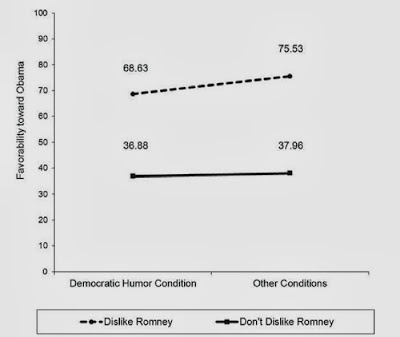
Ever wonder about the impact of those political parody videos you were watching during the 2012 Election cycle? While you might have found it funny to see Barack Obama or Mitt Romney made fun of, were others finding these things funny as well? Was anybody else watching? A new article I just published in Human Communication Research addresses these questions and more by applying the disposition theory of humor to the study of both political parody appreciation and the effects of humor exposure. First, a little background: The Pew Research Center reports that 55% of all registered voters went online during the 2012 Election cycle to watch political video . 37% watched humorous or parody videos dealing with political issues. So yes, you weren't the only one watching those YouTube clips. The research featured in the HCR article is based on an experimental study that asked subjects to watch one of three sets of videos: a set that featured Democratic-directed humor, one set that inc...

New Article: Public Opinion Toward Employment Discrimination, 1987-2012

Image
A new article I wrote on trends in public opinion toward employment discrimination is now available online at The International Journal of Public Opinion Research . The article will later be in print in the journal's special issue on Public Opinion about Gay Rights/Marriage being edited by Paul Brewer . The piece examines evolving views on whether school boards should have the authority to fire known homosexual teachers between 1987-2012 (N=35,578). In the process, I consider whether we have seen a sea change in public opinion on the issue similar to the dynamic we've recently been witnessing with the same-sex marriage debate. As the chart below shows, 51.5% of Americans expressed support for the practice when Pew first started collecting data in 1987. By 2012, only 21% of Americans still expressed support for the practice. These individuals are what researchers call the hard core , those who retain minority viewpoints in the face of majority opposition. As the results sugge...

Upcoming special issue of Mass Communication & Society: Entertainment Media and Politics

Image
I'm very excited for the Spring 2014 release of Mass Communication & Society's special symposium issue on Entertainment Media and Politics spearheaded by guest editor, R. Lance Holbert . It's really an honor to have my work included alongside the research of so many respected scholars of hybrid media including colleagues (and friends) Heather LaMarre , Kristen Landreville , and Danna Young . A table of contents for the special issue is pasted below. Happy spring reading! Volume 17, Number 3, 2014 • May-June Symposium—Entertainment Media and Politics Introduction R. Lance Holbert, Guest Editor Strike While the Iron is Hot: Seizing on Recent Advancements to Propel the Study of Political Entertainment Media Forward Articles Hoon Lee and Nojin Kwak The Affect Effect of Political Satire: Sarcastic Humor, Negative Emotions, and Political Participation Bruce W. Hardy, Jeffrey A. Gottfried, Kenneth M. Winneg, and Kathleen Hall Jamieson Stephen Colbert’s Civic Less...

Mixing Manual Human Effort with the Power of Machine Learning

Image
I really enjoy watching David Brooks and Mark Shields engage in a civil discussion of the week's news on the Friday broadcast of the PBS News Hour . While I don't always agree with David Brooks' politics, I do think he presents some very rational and pressing arguments in his work (his recent column on weed aside). In today's New York Times, Brooks critiques our heightened love of machines and the use of automation to replace human dependent tasks like driving cars or picking stocks. Brooks makes the point that even in this age of rapidly expanding technology, there are certain human activities that machines just can't replicate. Brooks is certainly right on some fronts. But maybe the question isn't a dichotomous one -- machine vs. human? Perhaps, as I've seen in my own recent work with a team of computer science colleagues , it's about using machines to enhance human efforts. Relying on techniques from the world of artificial intelligence (e.g., aut...

Future Directions for Political Comedy Research

Image
Now out in the latest edition of the National Communication Association's Communication Currents newsletter is an essay I've written with my colleague, Don Waisanen , about our recent review of the state of political comedy research. The essay translates our recent article published in Review of Communication where we focus on defining the current boundaries of political comedy research. We discuss how research focuses primarily on comedy's features (e.g., things like comedy's devices and conventions, ideological and ethical functions, and contributions to public affairs and civic discourse) and the effects of exposure to this entertaining content (e.g., key outcomes like knowledge and learning, attitudes, and political engagement). The piece also reviews recent work on how viewers process, interpret, develop an affinity for, and come to understand political comedy content. In the second half of the piece, we work to bridge the features and effects divide by offeri...

What the Jimmy Fallon/Bruce Springsteen "Gov Christie Traffic Jam" song says about Comedy and Politics

Image
2014 means it's time to get back to blogging. Anyone who knows me well also knows it's no secret that I am a big Bruce Springsteen fan. It's kind of a pre-requisite if you grew up in New Jersey. Perhaps the best part of my ICA 2013 London conference trip was that it overlapped with the E Street Band's stopover at Wembley Stadium in London . The ticket stub is proudly displayed in our house. Those who know the academic me also know that I spend a good chunk of my time researching the impact of exposure to political comedy and entertainment. Over the years I've found that exposure to political comedy is positively related to feelings of internal political efficacy or the belief in one's ability to effectively understand and participate in politics, that political comedy content can act as a gateway encouraging young people in particular to seek out political information from traditional news sources, and that viewing interviews on political comedy programs ...

Last Popular Culture & Politics Class: I am a Pole and So Can You

Image
Well the semester is FINALLY over and I'm happy to report that we had A LOT of fun in my new seminar, Popular Culture & Politics. While the 2012 election didn't provide quite as much entertainment as the 2008 Sarah Palin fest, we spent some quality time talking about SNL's new Barack Obama (Jay Pharoah), Mitt Romney style , and Stephen Colbert's Super PAC - Americans for a Better Tomorrow, Tomorrow . We tried to keep up with the various viral videos and comedy appearances that popped up during the election cycle. Here are some highlights: Lena Dunham's First Time: This one's not political but it did help us talk about Saturday Night Live: Barack Obama's appearance on The Daily Show: The Daily Show with Jon Stewart Mon - Thurs 11p / 10c Barack Obama Pt. 1 www.thedailyshow.com Daily Show Full Episodes Political Humor & Satire Blog The Daily Show on Facebook And last but not least, here's some more Lena Dunham: "You Don't...

Historic Election Night for Same-Sex Marriage Supporters

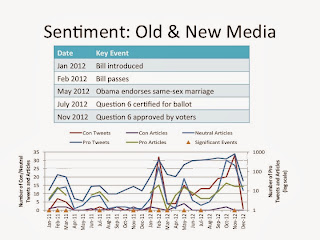
Last night, in a historic move, voters in Maryland and Maine approved the extension of marriage benefits to same-sex couples via ballot initiatives . After 32 failed attempts, same-sex marriage was finally approved by voters at the ballot box. At present, it looks like Washington voters will be supporting same-sex marriage as well, and in Minnesota, voters said no to an effort to amend the state constitution to solely define marriage as the union between one man and one woman. It was a great night for marriage equality supporters, with concrete evidence that public opinion has truly shifted in their direction -- at least in some states. What's responsible for the shift? As my own research has suggested, increasing rates of social contact with gay and lesbian friends, family members, and even co-workers and acquaintances has had a profound effect on the opinions of voters -- both young and old. Endorsements by Barack Obama and the NAACP made a difference on Question 6 in Maryla...

Teaching and Researching Political Comedy

Image
I wrote a piece for the October 2012 Faculty Voice (The University System of Maryland's faculty newspaper) entitled, "No Laughing Matter: Researching and Teaching about Comedy, Popular Culture, and Politics" Here's the intro: I watch The Daily Show and The Colbert Report for “homework.” At least that’s what I tell my students. In truth, as an academic researcher who studies the impact of popular culture and entertainment on political behavior and attitudes, I do consume more than my fair share of comedy content — the thing is, I’m not the only one tuning in. You can access the full piece here

TU in 2 Video on Political Comedy

Image
Towson University has been posting "TU in 2 videos" for a couple of semesters now. In these short videos, Towson faculty give a mini-lecture on their area of research expertise. In my video I talk about why academics study political comedy and the finding that not all comedy forms are created equal. Hostile humor, or traditional satire in which a comedian like Stephen Colbert or Jon Stewart pokes fun of a politician, results in viewers exhibiting more negative attitudes toward the comic target. Viewing self-directed humor, on the other hand, encourages viewers evaluate the politician more favorably. The lesson for politicians -- be able to both make and take a good joke. The full video is here: For more TU in 2 videos, check out some greats from Spring 2012 and Fall 2011

The Debates, Social Media, and #bindersfullofwomen

Image
Ready for tonight's final presidential debate? Having trouble with the fact that Election Day is just two weeks away? Wondering whether this final debate will make a difference in the poll results? Last week I spoke with WBAL-TV about the second debate and the social media response to Mitt Romney's #bindersfullofwomen comment. The full video of the interview is available here . In the interview, I discussed the democratizing potential of social media -- with sites like Twitter, Tumblr, and Facebook anyone can get involved in the political discussion. You can share your thoughts in 140 characters, create your own picture and caption on Tumblr, or share your views on who won the debate with members of your Facebook social network. We also talked about one of America's favorite Sesame Street characters -- Big Bird. While all eyes are on the third debate, new binders full of women photos still keep appearing on Tumblr . Some old and new favorites are included below. Enj...

#Rumble2012: For those who couldn't stream the event in that air conditioned auditorium

Image
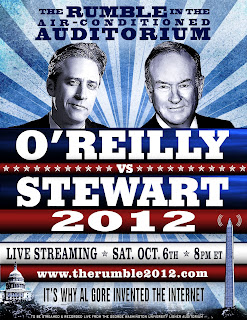
There was another debate this week, "The Rumble in the Air-Conditioned Auditorium" between Bill O'Reilly of FOX News and Jon Stewart of Comedy Central fame. For those who had trouble streaming the event live after paying their $4.95, The Washington Post offers a synopsis and five key take-aways . They also made a pretty comprehensive list of the best one-liners from the rumble. For those who watched the event the next day (like me), #rumble2012 was more deliberative than combative and serious than funny. Both O'Reilly and Stewart offered their perspectives on the current state of the economy, foreign policy, and their own personal views on the role of entitlements and government involvement in everyday life. For those who weren't able to get that streaming working, Slate offers a good summary here . And you can still purchase and now download a copy of the event on the now less-trafficked Rumble 2012 web site .

SNL, the 2012 Election, and Learning about Parody

There's a great article in today's New York Times about the influence of SNL during a competitive election season. As we've been learning in my TSEM class(Popular Culture and Politics: Comedy, Entertainment, Celebrity, and Democracy) this semester, journalists and the public alike look to the cast of SNL to offer their parody version of each general election debate. Parody is a reinterpretation of an original text -- a mockery that is easier to understand if you're familiar with the original event or script. According to the SNL writing team, this past Wednesday's debate failed to offer genuine comic inspiration. From the NYT article: "But the debate itself turned out to be a challenge. There were no big gaffes or obvious springboards for comedy. Instead, the first debate of this election offered up a blizzard of policy details and a lackluster performance from President Obama. At home Wednesday night, Seth Meyers, one of the show’s head writers, watch...

Update from TSEM102:Popular Culture and Politics

Image
It's hard to believe that the third week of classes is almost over at Towson University. We've been having a lot of fun in my Towson Seminar ( Popular Culture and Politics: Comedy, Entertainment, Celebrity, and Democracy ) and we've been reviewing some interesting video content In fact, I'm struck by how much material the 2012 campaign has already provided. We spent some time talking about Clint Eastwood's Invisible Chair debacle at the Republican National Convention -- what a great example of celebrity politics gone wrong! If you don't believe me, see for yourself: We've been giving equal treatment to the Democrats too -- a great gem from this past week was this New York Times article about Joe Biden's get together with a group of bikers in Ohio. The NYT journalist penning the piece, Sarah Wheaton, offers some spot on commentary regarding the picture featured in the article. Even she can't believe it's not ripped from the pages of The Oni...