Posts

Showing posts with the label parody

Disposition, Political Parody, and the 2012 Election
Image
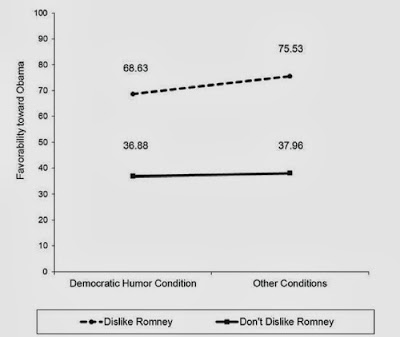
Ever wonder about the impact of those political parody videos you were watching during the 2012 Election cycle? While you might have found it funny to see Barack Obama or Mitt Romney made fun of, were others finding these things funny as well? Was anybody else watching? A new article I just published in Human Communication Research addresses these questions and more by applying the disposition theory of humor to the study of both political parody appreciation and the effects of humor exposure. First, a little background: The Pew Research Center reports that 55% of all registered voters went online during the 2012 Election cycle to watch political video . 37% watched humorous or parody videos dealing with political issues. So yes, you weren't the only one watching those YouTube clips. The research featured in the HCR article is based on an experimental study that asked subjects to watch one of three sets of videos: a set that featured Democratic-directed humor, one set that inc...

Upcoming special issue of Mass Communication & Society: Entertainment Media and Politics

Image
I'm very excited for the Spring 2014 release of Mass Communication & Society's special symposium issue on Entertainment Media and Politics spearheaded by guest editor, R. Lance Holbert . It's really an honor to have my work included alongside the research of so many respected scholars of hybrid media including colleagues (and friends) Heather LaMarre , Kristen Landreville , and Danna Young . A table of contents for the special issue is pasted below. Happy spring reading! Volume 17, Number 3, 2014 • May-June Symposium—Entertainment Media and Politics Introduction R. Lance Holbert, Guest Editor Strike While the Iron is Hot: Seizing on Recent Advancements to Propel the Study of Political Entertainment Media Forward Articles Hoon Lee and Nojin Kwak The Affect Effect of Political Satire: Sarcastic Humor, Negative Emotions, and Political Participation Bruce W. Hardy, Jeffrey A. Gottfried, Kenneth M. Winneg, and Kathleen Hall Jamieson Stephen Colbert’s Civic Less...

What the Jimmy Fallon/Bruce Springsteen "Gov Christie Traffic Jam" song says about Comedy and Politics

Image
2014 means it's time to get back to blogging. Anyone who knows me well also knows it's no secret that I am a big Bruce Springsteen fan. It's kind of a pre-requisite if you grew up in New Jersey. Perhaps the best part of my ICA 2013 London conference trip was that it overlapped with the E Street Band's stopover at Wembley Stadium in London . The ticket stub is proudly displayed in our house. Those who know the academic me also know that I spend a good chunk of my time researching the impact of exposure to political comedy and entertainment. Over the years I've found that exposure to political comedy is positively related to feelings of internal political efficacy or the belief in one's ability to effectively understand and participate in politics, that political comedy content can act as a gateway encouraging young people in particular to seek out political information from traditional news sources, and that viewing interviews on political comedy programs ...

SNL, the 2012 Election, and Learning about Parody

There's a great article in today's New York Times about the influence of SNL during a competitive election season. As we've been learning in my TSEM class(Popular Culture and Politics: Comedy, Entertainment, Celebrity, and Democracy) this semester, journalists and the public alike look to the cast of SNL to offer their parody version of each general election debate. Parody is a reinterpretation of an original text -- a mockery that is easier to understand if you're familiar with the original event or script. According to the SNL writing team, this past Wednesday's debate failed to offer genuine comic inspiration. From the NYT article: "But the debate itself turned out to be a challenge. There were no big gaffes or obvious springboards for comedy. Instead, the first debate of this election offered up a blizzard of policy details and a lackluster performance from President Obama. At home Wednesday night, Seth Meyers, one of the show’s head writers, watch...

Update from TSEM102:Popular Culture and Politics

Image
It's hard to believe that the third week of classes is almost over at Towson University. We've been having a lot of fun in my Towson Seminar ( Popular Culture and Politics: Comedy, Entertainment, Celebrity, and Democracy ) and we've been reviewing some interesting video content In fact, I'm struck by how much material the 2012 campaign has already provided. We spent some time talking about Clint Eastwood's Invisible Chair debacle at the Republican National Convention -- what a great example of celebrity politics gone wrong! If you don't believe me, see for yourself: We've been giving equal treatment to the Democrats too -- a great gem from this past week was this New York Times article about Joe Biden's get together with a group of bikers in Ohio. The NYT journalist penning the piece, Sarah Wheaton, offers some spot on commentary regarding the picture featured in the article. Even she can't believe it's not ripped from the pages of The Oni...